
First direct look into the in vivo neuronal activity in the vicinity of Alzheimer-plaques
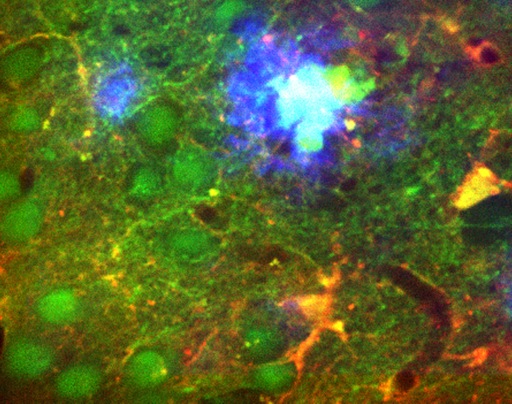
Alzheimer's disease is the most common form of dementia affecting millions of people worldwide. This incurable, degenerative and terminal disease ultimately leads to a severe loss of mental function. This loss was until now explained by a progressive decrease in neuronal activity caused by the breakdown of the connections between certain neurons in the brain and their eventual death. Anatomical studies supported this notion by showing that already early stages of Alzheimer's disease are associated with a decrease in the density of cortical synapses and dendritic spines. Furthermore, results obtained in various animal models of the disease have shown amyloid ß mediated inhibition of synaptic currents, disruption of synaptic plasticity as well as endocytosis of glutamate receptors. In the recent study (Busche et al. 2008, Science 321, 1686-1689) our group in collaboration with Novartis Pharma AG and µmLMU Munich provided direct evidence extending the previous view.
Using high resolution in vivo imaging in a mouse model of the disease we were able for the first time to monitor directly the behavior of neurons located near amyloid plaques, a major histological marker of Alzheimer's disease. Surprisingly, almost a quarter of these cells showed an increase in neuronal activity. These `hyperactive' neurons were found exclusively in the close vicinity of amyloid plaques (<60 µm from the plaque border) and only in older mice, in which amyloid plaques are present. The appearance of hyperactive cells correlated with a distinct impairment of cognitive behavior. A few lines of evidence suggested that this hyperactivity is due to a relative decrease in synaptic inhibition in the peri-plaque regions. The hyperactive cells were very often active in synchrony. This observation provides a possible explanation for the increased incidence of epileptic seizures in patients.
In line with the 'synapse breakdown' hypothesis we also observed a 4-fold increase in the number of 'silent' cortical neurons, neurons which were inactive during the whole recording period. Together with hyperactive neurons these cells summed up to 50% of the total neuronal population reflecting a severe change in brain function.
These new data suggest that a redistribution of synaptic drive between silent and hyperactive neurons, rather than an overall decrease in synaptic activity, provides a mechanism for the disturbed cortical function in Alzheimer's disease.
See also:
- 45 views